T-Flux Ultra
A private enterprise AI orchestration platform for controlled model use, information retrieval and operations.
 Book a discovery session
T-Flux Ultra Mentor
The next competitive advantage in AI is not simply using the latest models. It is running them better than everyone else.
T-Flux Ultra Mentor provides the basis to create specialised, domain-specific expert Large and Small Language Models trained exclusively on an organisation's proprietary data and intellectual property.
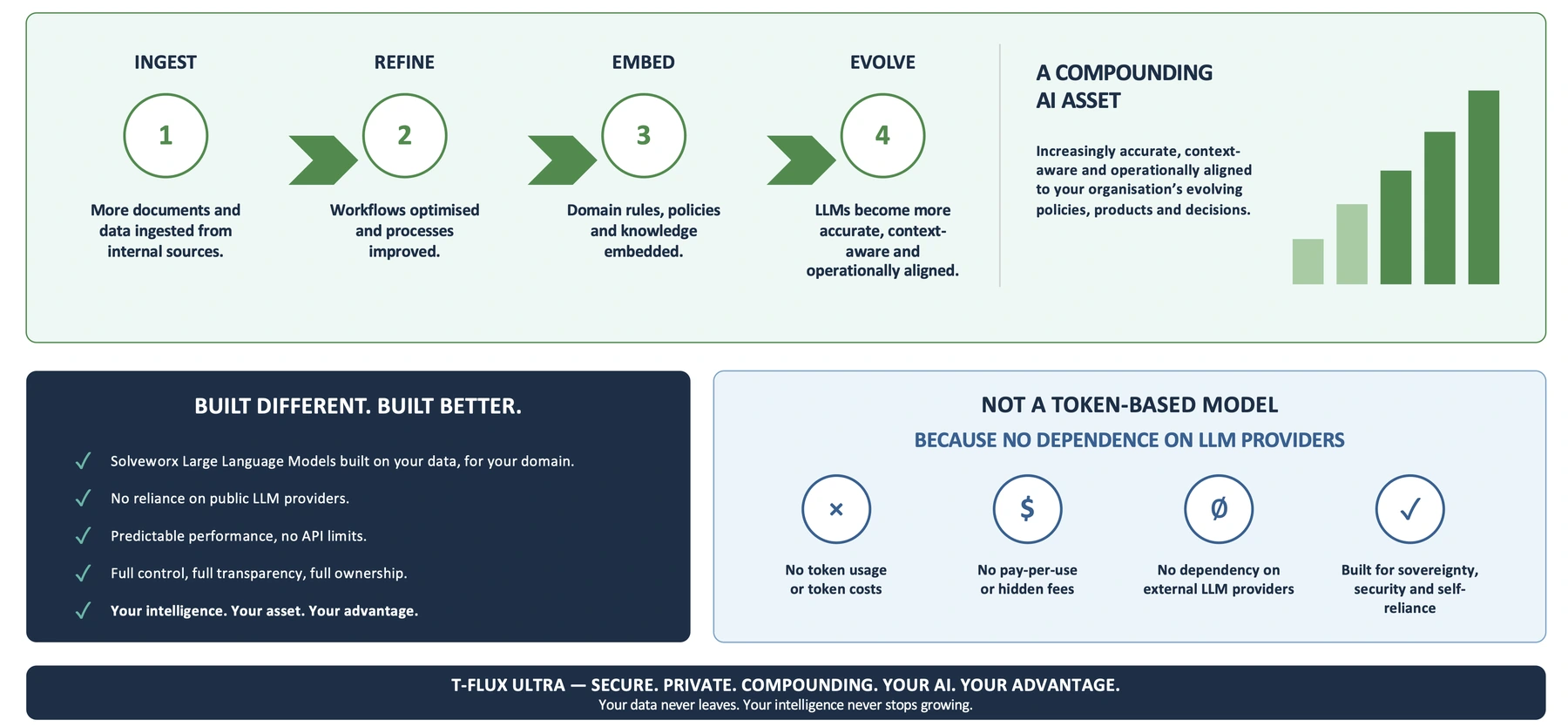
A compounding AI asset
Expert SLMs evolve into valuable enterprise assets over time: AI systems that understand the company's language, policies and processes better than an external model can.
The intelligence that grows inside a customer's environment belongs entirely to that enterprise. Every document ingested, workflow tuned and decision refined strengthens the customer's proprietary private model.
What are Small Language Models?
Solveworx Small Language Models are trained entirely on the organisation's own databases and internal knowledge, then deployed inside the organisation's infrastructure, on-premises or in a private cloud.
Built on industry-standard GGUF formats, they provide a low-risk, portable approach to enterprise AI that avoids vendor lock-in and supports controlled lifecycle management. Training, inference and retrieval remain within the customer's private perimeter, with no external data exposure.
As documents are ingested, workflows are refined and domain rules are embedded, the SLM becomes increasingly accurate, context-aware and operationally aligned to the organisation's evolving policies, products and decisions.
Why SLMs matter
A private enterprise AI orchestration platform for controlled model use, information retrieval and operations.
AI data science and computational mathematics that continually optimise model architecture, inference, GPU utilisation and cost.
Together, these capabilities help organisations deliver measurable business outcomes from enterprise AI.
Customer-owned SLMs
T-Flux lets enterprises build specialised, domain-specific models trained exclusively on their data, policies, terminology and workflows.
Creation and training workflow
Mentor brings model definition, data preparation, knowledge grounding, tuning, quality validation and controlled model release into one end-to-end process.
Set the business role, intended users, outcomes and boundaries for the SLM.
Identify approved enterprise information and intellectual property for the model.
Confirm the access, visibility and policy controls that govern the corpus.
Index, parse, structure and prepare information for training and retrieval.
Train or tune the SLM for the organisation’s domain, language and workflows.
Benchmark quality, apply guardrails and review the model against approved measures.
Release the approved model into the governed T-Flux Ultra environment.
Use T-Flux Ultra's advanced Control Plane dashboard to get a single view of your entire data domain.
Governed enterprise data
End-to-end AI in T-Flux depends on a governed enterprise data plane: a connector and ingestion layer that brings enterprise knowledge into the AI environment under controlled conditions.
Permissions, trust and policy
A governed permissions layer applies controls to the information used by the SLM and to the way its responses are handled. T-Flux also supports RBAC, ABAC, SSO, ACL-aware retrieval, audit logging, policy enforcement and explainability.
Prompt, reasoning and response
T-Flux gives enterprises visibility into and control over the AI reasoning process, including guardrails, security rules, operational limits and policy-aware response handling.
Your intelligence. Your asset. Your advantage.
Keep your data, models and institutional intelligence within the environment you control.
Discuss T-Flux Ultra Mentor