Documents and enterprise files
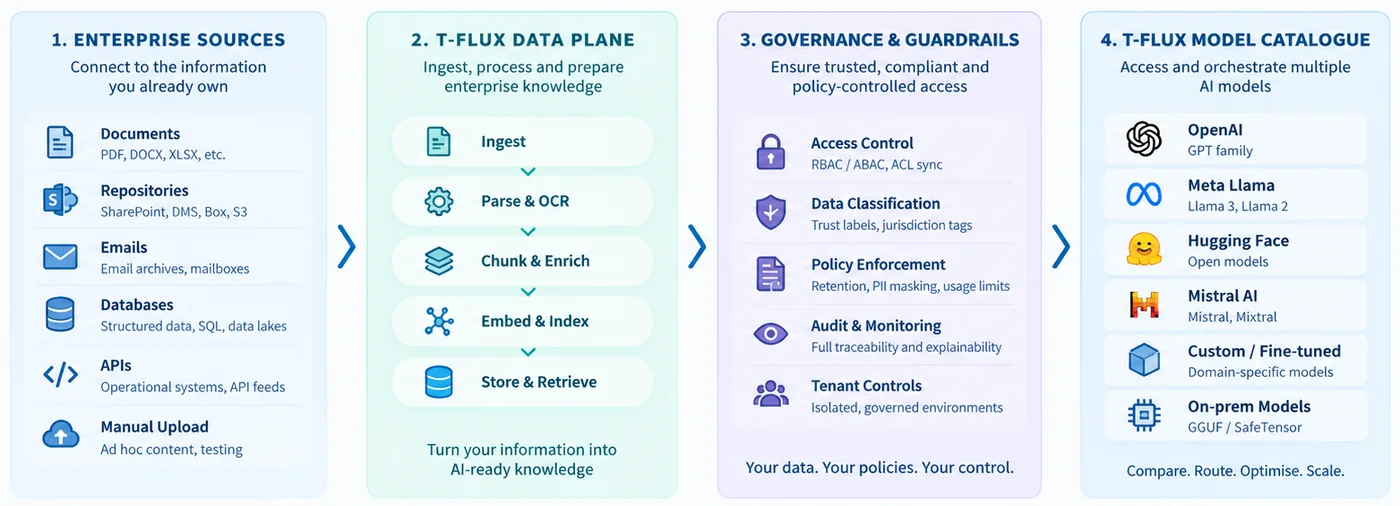
PDF, DOCX, XLSX, and uploaded artefactsConnect reports, policies, contracts, spreadsheets, manuals, procedures, research material, and other enterprise documents through a governed ingestion pipeline.
 Book a discovery session
Data Catalogue
T-Flux Ultra gives customers granular control over enterprise data at every stage of the AI lifecycle.
Data can be version-controlled, governed, and managed from ingestion through to retrieval and model use.
Granular data governance
Organisations can determine which version of a document or data set is current and authorised for AI use; when a new version is introduced, approved, superseded, or retired; and who may access information by user, role, tenant, agent, or model.
Policies can govern classification, retention, indexing, embedding, retrieval, exposure to a model, human approval, and audit trails at each processing stage.
Data sources and types
Connect reports, policies, contracts, spreadsheets, manuals, procedures, research material, and other enterprise documents through a governed ingestion pipeline.
Keep existing repositories as the authoritative source while T-Flux creates the indexes, metadata, and retrieval capability required for enterprise AI.
Incorporate approved email repositories, internal knowledge bases, operating procedures, wikis, and institutional knowledge into a governed retrieval environment.
Connect current structured information from databases, applications, and API-enabled systems while retaining existing application and data boundaries.
Authorised users can add approved information for temporary use, testing, analysis, or inclusion in a governed knowledge corpus.
AI-ready knowledge
Connecting information is only the first step. T-Flux prepares enterprise information so it can be reliably retrieved and used by approved AI models.
Bring approved enterprise sources into the governed environment.
Process formats and use OCR where needed to make content usable.
Add source, ownership, classification, and context metadata.
Create vector and keyword indexes for efficient discovery.
Provide the most relevant authorised information as contextual evidence.
This is the foundation of Retrieval-Augmented Generation. T-Flux can ground AI responses in the organisation's own authoritative information rather than relying solely on the information contained inside a large language model.
Data sovereignty
Corporate data remains under corporate control. T-Flux does not require an organisation to relinquish ownership of its information in order to use AI.
Data can remain within on-premises infrastructure, private cloud, approved data centres, controlled enterprise repositories, and jurisdictional boundaries.
T-Flux operates as the orchestration and governance layer between enterprise data, applications, users, and AI models. The organisation retains control over what information can be accessed, who can access it, which models can use it, and for what purpose.
Governance before AI access
Synchronise existing repository permissions so users and AI workloads retrieve only information they are entitled to access.
Apply RBAC and ABAC policies by role, business unit, security level, application, or other customer-defined attributes.
Assign trust labels that determine how and where information can be used.
Tag information by geographic or regulatory jurisdiction to support sovereign and regulatory requirements.
Keep information subject to enterprise retention and lifecycle requirements.
Identify, mask, or redact PII and protected information according to customer-defined policy.
Data-aware multi-model orchestration
The Model Catalogue provides access to multiple AI models within the same governed environment. The Data Catalogue and Data Plane provide the approved enterprise context those models are allowed to use.
Customer-defined policies can determine which model handles a request, which enterprise information it is permitted to see, which sources are relevant, which guardrails apply, and how the resulting response is validated and recorded.
Operational visibility
The T-Flux Ultra Data Plane provides operational visibility over the complete enterprise AI information lifecycle, including connected sources, ingestion volumes, document processing, OCR and parsing success, indexing, embedding creation, vector database utilisation, retrieval performance, failures and retries, access-control enforcement, knowledge-source utilisation, and data lineage.
Explore the Data Plane