Deployment boundary
On-prem, private cloud, or Solveworx-hosted enterprise environment.
 Book a discovery session
Architecture
Solveworx T-Flux Ultra is not a single model or a simple interface layer. It spans deployment, ingestion, governed retrieval, orchestration, proprietary SLM creation, workflow automation, governance, and observability in one enterprise operating platform.
Platform stack
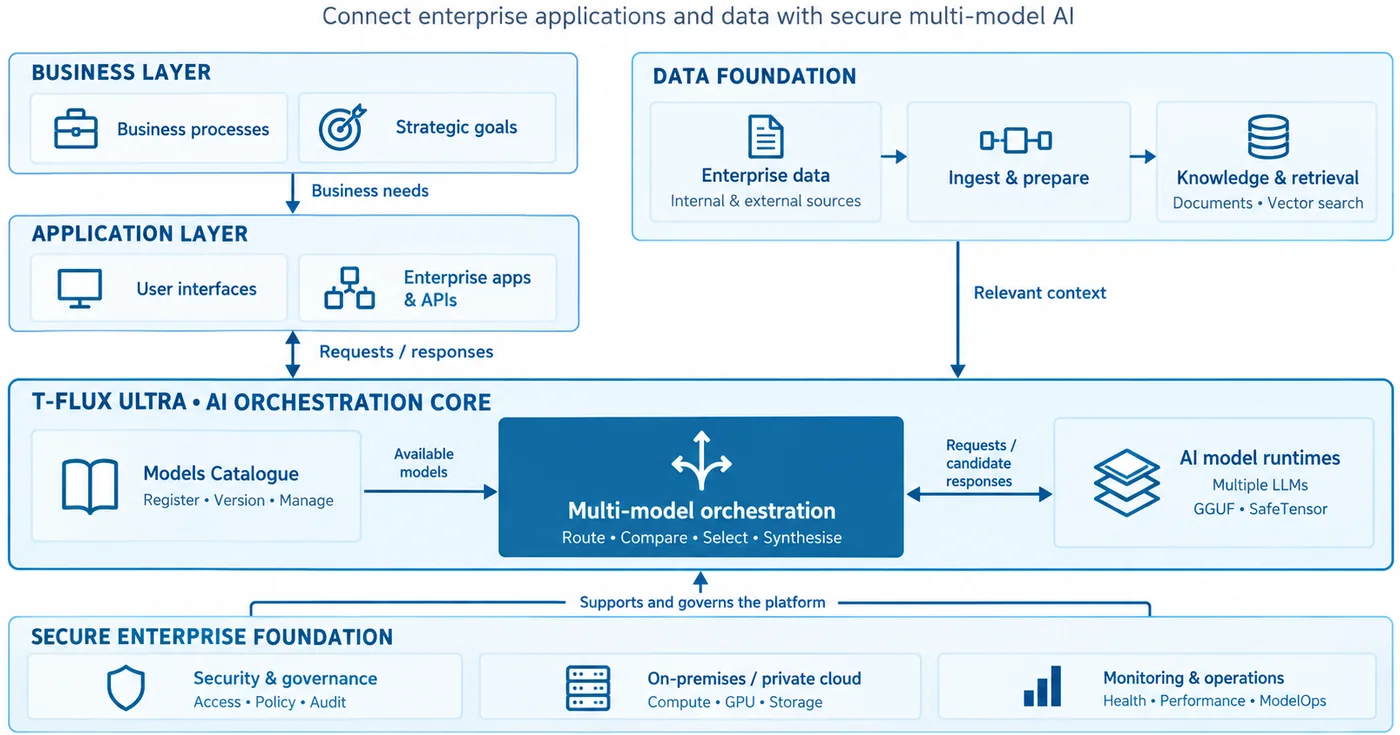
This visual stack explains how T-Flux connects enterprise applications and data with secure multi-model AI.
Platform stack
Every layer is designed to work together, from a controlled deployment boundary through to evidence-led operations.
On-prem, private cloud, or Solveworx-hosted enterprise environment.
Workspace isolation, security baseline, identity, and enterprise administration.
On-site model integration for approved model families, GGUF, SafeTensor, and private endpoints.
Connectors, documents, repositories, databases, APIs, metadata, ACLs, and retrieval control.
Purpose definition, source onboarding, corpus preparation, train and tune, validation, and publication.
Multi-model synthesis, policy-aware response generation, and workflow control.
Agents, batches, scheduled tasks, and job execution history.
Compute and Models, Data Plane, Quality and Governance, Batches and Agents, Reporting and Exports.
Data flow
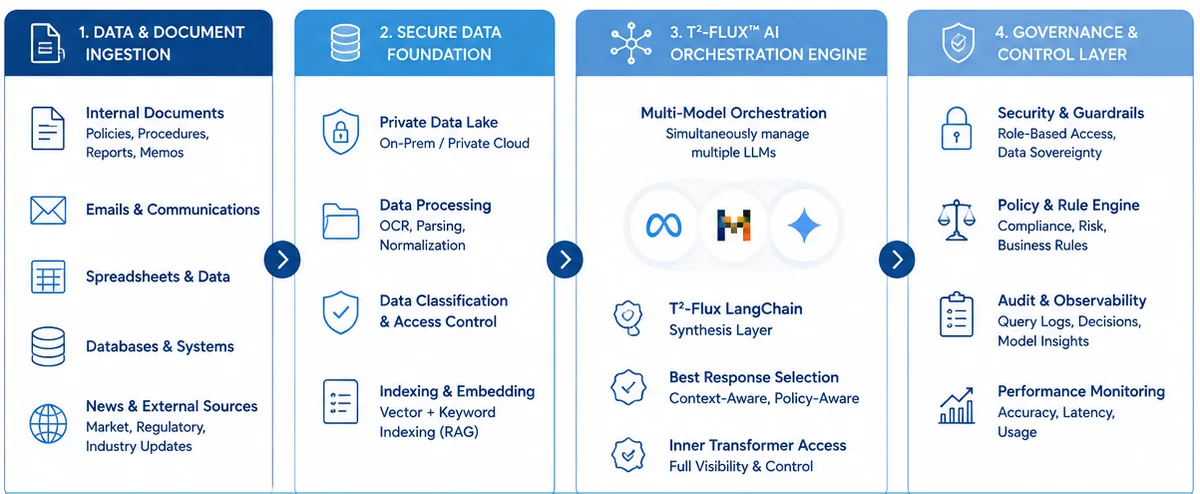
The architecture is strongest when shown as an end-to-end flow rather than as disconnected components.
Documents, systems, repositories, APIs, and knowledge sources.
Apply ACLs, trust labels, visibility rules, and lifecycle controls.
Ground prompts in enterprise sources using policy-aware access.
Route requests across approved models and synthesis logic.
Capture evidence, metrics, policy outcomes, and exports.
Enterprise outcome
T-Flux brings data, approved models, governed retrieval, orchestration, workflows, and audit-ready observability into a coherent enterprise platform.